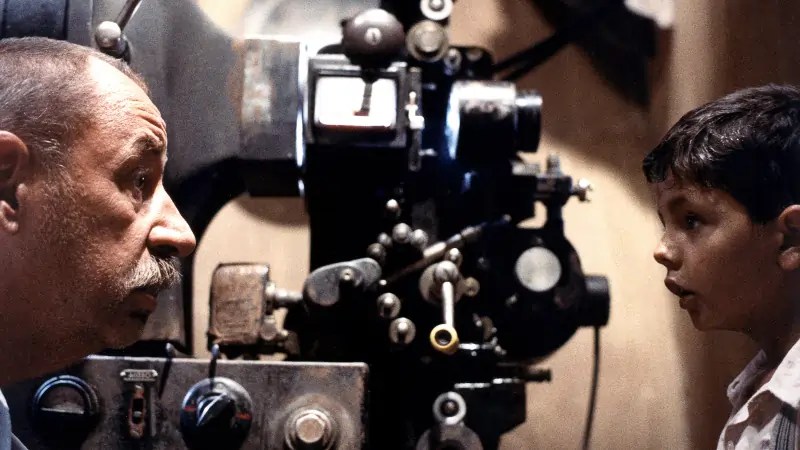
When you look back at the history of cinema, there are very few films that successfully bridge the gap between mainstream, arthouse, and world cinema in a way that resonates globally. The Artist was arguably the last to do so. But in 1988, an unknown Italian film—Giuseppe Tornatore’s Cinema Paradiso—managed to close that gap with unforgettable charm. Now, 25 years later, the film returns, fully restored, to captivate a new generation of film lovers while rekindling the affection of those who embraced it decades ago.
Set (and filmed) in the director’s hometown in the Sicilian hills, the story follows Salvatore (Jacques Perrin), a successful film director who returns home for the funeral of a dear friend—and more importantly, a mentor. That man was Alfredo (Philippe Noiret), the projectionist at the local theatre, Cinema Paradiso—the place that fueled Salvatore’s childhood imagination. But Salvatore doesn’t just recall his youth; he reflects on everything that shaped his life, including his first love, Elena (Agnese Nano), as he reconnects with the people he left behind 30 years earlier.
When you look at cinemas nowadays, it’s hard to believe that decades ago, theatres were at the heart of community life. Just like in Cinema Paradiso, they were a vital source of entertainment. They brought people together during turbulent times—like war—not for arguments about what to watch, but for the sheer joy of shared escapism. That relevance still exists today. Yet now, the focus has shifted to expensive ticket prices, overpriced popcorn, and empty auditoriums—a once passionate relationship many cinephiles now say has grown stale.
As I’ve said many times before, these reviews of older films are like that dusty bottle of aged malt whisky sitting in your dad’s drinks cabinet. You may not appreciate it when you first buy the bottle, but with time and patience, the true quality shines through. Cinema Paradiso, 25 years on, is that finely aged malt now being cherished. Winner of the Best Foreign Language Film Oscar in 1989—among many other accolades—it’s ironic that such a special film was a box office flop upon release.
Cinema Paradiso’s true power lies in its ability to celebrate cinema itself while tenderly telling a coming-of-age story. It’s a fantasy—not of Salvatore’s life, but of the enchanting magic of film. It mesmerizes, grips, and transports you into a world of emotional escapism, reminding us why the silver screen holds such a timeless allure. The first part of the film is dedicated to Salvatore’s childhood and the moment he first discovers the magic unfolding on screen. It’s also when Alfredo enters his life, becoming the father figure he never had—his own father having died during the war.
As the friendship between Alfredo and Salvatore blossoms, Cinema Paradiso offers a glimpse into the power of community during troubled times. There are even moments of light-hearted humour—particularly when the church attempts to censor the cinema, only for audiences to be treated to a montage of kisses cut from various films. If those censors were alive today, they might not survive the modern movie landscape!
From the innocence of childhood to the reflections of adulthood, nostalgia becomes a lens for introspection. Tornatore proves himself a master storyteller—something many of today’s filmmakers have seemingly forgotten.
Cinema Paradiso may be seen by some as overly sentimental or melodramatic, but there’s beauty in its simplicity. It’s a whimsical, heartfelt journey through life, friendship, and the romance of cinema itself. Life is hard. Still, the film’s feel-good nature reminds us of the importance of community. It also highlights the joy of escaping life’s troubles, even briefly. The film has a breathtaking score by Ennio Morricone. It is complemented by stunning cinematography. Cinema Paradiso is a love letter to cinema. It’s one you’ll treasure in your heart until the end of days.
★★★★
World Cinema, Drama | Italy, 1988 | 15 | Arrow Films | 16th December 2013 (UK) | Dir:Giuseppe Tornatore | Enzo Cannavale, jacques perrin,Philippe Noiret, Salvatore Cascio,
This post was originally created for the film’s 25th Anniversary release posted at Cinehouse on 16th December 2013.




 Chronicles in film
Leave a comment