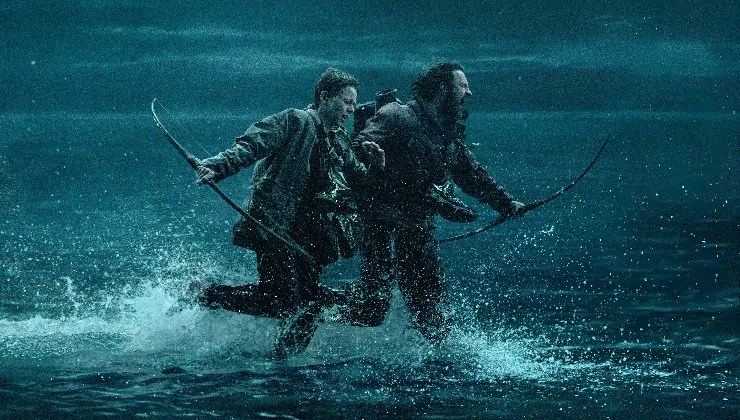
22 years after the infected roamed British cinematic lands, Rage still exists, and time heals no one in 28 Years Later.
Danny Boyle returns to direct the long-awaited sequel, with Alex Garland also back on scripting duties.
Talk of a sequel has been on the minds of Boyle and Garland for years. As with many things, other commitments and the lack of the right idea delayed progress.
In 2007, we got 28 Weeks Later, directed by Spanish filmmaker Juan Carlos Fresnadillo (whose most recent film was 2024’s Damsel, starring Millie Bobby Brown on Netflix). It starred Robert Carlyle, Rose Byrne, Imogen Poots, and Jeremy Renner, to name a few. But before fans got too excited, it was made clear this would be a standalone film.
The original 28 Days Later starred a young Cillian Murphy in one of his breakthrough roles. He was joined by Naomie Harris, Brendan Gleeson, and Christopher Eccleston. Just when you thought it was about the infected, the film reminded us that humanity itself, the survivors were the true monsters.
When 28 Years Later entered production, fans were thrilled to hear that Murphy was also involved. So when the first trailer dropped, all eyes were scanning for the Oscar-winning Irish actor. How disappointed many were to learn he’s not in this installment (only attached as an executive producer). Instead, he’ll appear in 28 Years Later: The Bone Temple. The film is directed by Nia DaCosta, known for the Candyman reboot. It is set for release on January 2026.
The last time we visited this world, Jim, Selena, and Hannah were surviving in the northwest of England. Now, we find ourselves in the northeast, where humanity has learned to live with Much of the story centres on a community living on an isolated island (the real-life Holy Island) accessible only at low tide via a causeway. Try to cross at high tide and you’ll drown, dragged in the opposite direction.
28 Years Later follows one family from this isolated community: 12-year-old Spike (newcomer Alfie Williams), his father Jamie (Aaron Taylor-Johnson), and his sick mother Isla (Jodie Comer). Jamie decides to take Spike on his first “blooding” — his first infected kill.
Like many young people, Spike is terrified of what’s happening but also curious about what the world has to offer — even if that world could kill him. After witnessing something on the mainland and learning a story tied to it, Spike returns there with his mother, embarking on a journey he never anticipated.
28 Years Later is a unique sequel — one that can easily stand alone. It’s a coming-of-age story for Spike, a boy growing up in a world where children are forced to mature quickly to survive. As he walks toward the community gates, his father is reminded: “He’s a bit young.”
The film places a strong emphasis on the family unit, and could even be read as an allegory for Brexit. We learn that the UK has been cut off from mainland Europe, with boats patrolling the coast to make sure no one escapes. Communities stay isolated and suspicious of outsiders. Those who live beyond the safety of their enclave are seen as dangerous — or simply forgotten. This is a story not just about post-Brexit anxiety, but also post-pandemic trauma. Since 2020, society has grown more divided, more fearful, more “patriotic,” and more wary of outside human contact.
Once the film moves beyond the island, we glimpse remnants of the old world: deserted streets, overgrown towns, nature reclaiming man’s domain. Some areas, now free of infection, are even more violent and lawless. The film also touches on Britain’s imperialist history and the horrors of war. The opening archive footage shows kings and soldiers, overlaid with Rudyard Kipling’s chilling poem Boots — a stark reminder of the past, and a haunting ode to the soldiers of the Second Boer War.
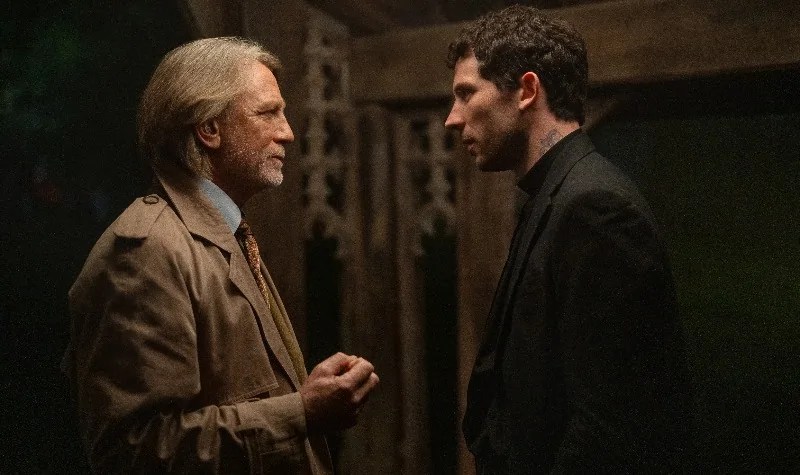
Jamie seems to have given up on his ailing wife; like the infected, his primal instincts start to take over. Spike, aware that his father’s actions are wrong, takes his mother outside the community in search of Kelson (Ralph Fiennes), a man with another “life.” Many from the island know of Kelson’s past, but now view him as strange — obsessed with death.
If you thought the infected in the previous films were terrifying, they’ve changed — for the worse. The film hints that behind the primal rage, there may be an evolution, even a kind of infected “circle of life.” Like The Last of Us, different classes of infected exist now: the Slow Lows (bloated bottom-feeders ) and the Alphas, taller, stronger, capable of ripping your head and spine clean off.
28 Years Later’s cinematography is grimy and kinetic. Cinematographer Anthony Dod Mantle used iPhone to shoot, placing the camera close to characters’ faces to capture their anxieties. The immersive sound design plugs directly into the chaos — even making you fear the silence. The tension-building is sublime and visceral.
The script has been seen by many as the film’s weak point, acting more as setup for The Bone Temple. The ending is a real WTF moment, one that will make you cringe or laugh. It introduces a character who will shape or break Spike, turning him into one of the monsters we’ve become. To say more would be a spoiler, but the final scenes tip the film’s tone into dark humour.
You can’t help but wonder: if Danny Boyle had made 28 Years Later years ago, would it have been as effective? Probably not.
★★★1/2
Horror, Thriller | UK, 2025 | 15 | In Cinemas Now | Sony Pictures Releasing | Dir. Danny Boyle | Alfie Williams, Jodie Comer, Ralph Fiennes, Aaron Taylor-Johnson



 Chronicles in film
Leave a reply to Listen To The Chronicle Episode 46 – 28 Years Later & F1 – Chronicles in film Cancel reply